
Shreya Singhal
The narrative of female identity has always involved the idea of menstruation as essential to it. You are told that you grow from a girl into a woman after you get your first period, that bleeding every month is a marker of your femininity and something that is essential for childbirth. It has further gone to strengthen the binary between male and female. In this process, the complexity of the gender and sex spectrum fails to be understood well.
Even today, there are many questions regarding sexual orientation that is non-binary, and it only fits that menstruation poses a conflict in its understanding. There is not much awareness about the fact that not only women, but also transgender men and people who identify as men, menstruate. While women fight menstruation taboos to this day, queer menstruation is a subject entrenched in even greater taboos due to its intersectional nature.
Queer menstruation comes with its added layer of challenges as it is majorly an alien concept and thus, is forced to be hidden from the society. Women’s menstruation is subject to embarrassment sometimes, but queer menstruation is subject to disgust and maybe even rejection. If a transgender man bleeds every month, he is subject to discomfort and gender dysphoria and the transition to the acquired gender becomes difficult.
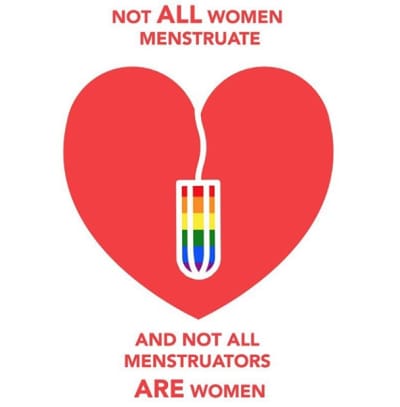
The market caters to menstruation as a feminine product and menstrual hygiene products, more often than not, have women representing the product, from being in advertisements to brand logos. This creates a psychological barrier for other gender identities to be able to identify with the product. Moreover, public spaces have proven to be another obstacle. Public washrooms are largely discriminatory when it comes to the being menstruation-friendly. Men’s washrooms do not hold menstruation hygiene products and this can create a problem for people who identify as males. Moreover, disposal of sanitary products can be an issue in men’s washrooms which are not adequately equipped for that.
There is added fear and shame of being ostracized for queer persons who might not want to expose themselves while unwrapping sanitary products or using and disposing them. It can be mentally taxing for such individuals who have to be constantly aware of their conflicted identity, and live with constant fear of being ostracised.
On the other hand, because of the gendered label of this process, transgender women who are not able to experience menstruation undergo gender or identity dysphoria as well. They feel that they are not able to experience the apparent milestone of femininity.
Queer individuals also face discrimination in healthcare, as health professionals can be biased against queer people or not understand their specific and unique health issues. They might not be adept in dealing with the complex issues of menstruation for the queer individual. This further increases their vulnerability.
Now more than ever, menstruation needs to be more inclusive through sensitive measures that cater to the nuanced needs of individuals across the gender spectrum. Schools in New York University have taken the initiative to make sanitary products accessible in the campus space, especially in gender-neutral and women’s washrooms. This is one example of the many potential steps that can be taken to make menstruation more inclusive. It is high time that menstruation became a thing of ‘Pride’.
 Red Badge Of Courage